 Home | Contact us
PCTRAN Presentation
To
GE Hitachi Nuclear Energy
May 20, 2008

Dr. Li-Chi Cliff Po
10 Navajo Court
Montville, New Jersey 07045, U.S.A.
Tel 973-263-7327 Fax 973-402-9456
[email protected] http://www.microsimtech.com
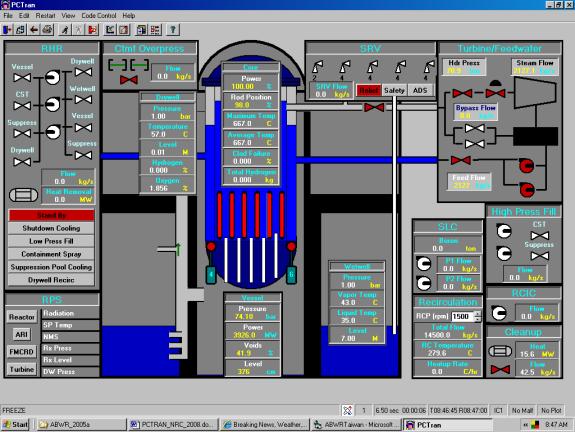
- PC-based Simulator in Windows XP Environment, written in Microsoft Visual Basic 6
- Reduced-node Thermal Hydraulics & Point Kinetics Core, Drift-flux model for void calculation
- Simplified 3-element control for feedwater and PAI control for turbine header pressure
- Active and Passive Cooling Systems, pressure suppression DW and suppression pool of Mark I, II, III and advanced containment
- Existing plant specific models licensed to utilities include BWR 2 for Oyster Creek and Tsuruga 1, BWR 4 for ChingShan, Muehleberg and Wuergassen, BWR5 for LaGuna Verde, BWR6 for Kwosheng and Leibstadt
- Has ABWR for Lungmen Project since 2001 and recently completed ESBWR
- Generic models licensed to USNRC since 1986, IAEA since 1996, and NUPEC and JNC of Japan (now JNES) since 1999
- All verified against FSAR Chapter 6 ECCS and 15 Safety Analyses
- Options of severe accident and dose dispersion models
- Has been used for training, SAMG development, emergency exercise and PRA event tree consequence study
- New plant models can be used for pre-construction training of NRC and utility personnel
- All new and existing plant models download available
- Development resource includes INER, leading universities in US and overseas. Two PhD’s and dozens of MS graduates
ABWR
- No External Recirculation loops and Pumps; Reduced maximum possible break size and possibility
- Ten Reactor Internal Pumps; 4 tied to reactor trip and remaining 6 to MG-set
- High Pressure Core Flooder (HPCF), RCIC, ADS, LPCI, Containment Over-Pressure Protection Systems
- Developed for Taiwan Power Company’s Lungmen (Dragon Gate) Project
- Also licensed to Taiwan Institute of Nuclear Power Research (INER)
- Used as the plant in INER’s digital control system design for fault-detection and reliability study
- INER has replaced PCTRAN’s plant control and protection systems with control logic using MATLAB/SIMULINK or actual control elements (hardware); See separate PowerPoint slides
ESBWR
- Natural circulation core, isolation condenser and 10 SRV’s (ADS) for SBLOCA, 8 SV’s and 8 DPV’s for over-pressure relief and depressurization after LBLOCA
- PCCS for containment passive cooling
- ARI, FMCRD and SLC for ATWS
- GDCS for coolant makeup after depressurization
- HP CRD and cleanup system for normal coolant inventory and purity control
- Feedwater level and turbine header pressure control

Severe Accidents
- Use 6-node vertical core Model with decay heat properly distributed.
- Two extra nodes for bottom of vessel metal and melted debris make total 8 nodes in the core.
- Metal-water interaction and generation of hydrogen will be accounted for in each node.
- Hydrogen may be detonated if concentration reaches the ignition condition.
- Containment failure may be resulted by heat, pressure or combination of both.
- Melting in each node may take place if calculated temperature exceeds the melting point.
- Corium-Concrete Interaction in the reactor cavity
- Release source terms
- Can generate HCTL, containment spray initiation limit, reactor depressurization and containment vent 2-D diagrams according to EOPS or SAM Guidelines

Offsite Dose Dispersion
- Generates Radiological Release Source Terms including Iodine, Noble Gases and Fuel Elements
- Gaussian puff model for dose projection in 10-mile and 50-mile EPZ
- Project Downstream Dose Rate and Accumulation for Exposure, Inhalation and Deposition
- Windows XP Web-based, Operates Online Connecting Control Room, TSC, EOF and Company HQ
- Scenarios Cover Severe Accidents, Spent Fuel Pool Failure and Intentional Sabotage
